Controlling Multicast on the LAN
How to manage IPv4 and IPv6 multicast on your LAN with Infix OS
Multicast lets one sender reach many receivers with a single stream: a camera feeding several operator stations, a controller publishing data to a group of devices, or a service announcing itself on the LAN. The sender addresses a group, and the network delivers a copy to every receiver that has joined it.
This post covers how a switch decides where that copy goes, what IGMP and MLD have to do with it, and how to set it up in Infix OS. It ends with what is new in Infix OS v26.10: a querier for IPv6, from mcd 3.0.
Multicast on a Switch
A multicast frame has a group as its destination, not a port. A switch that knows nothing more forwards it the way it forwards broadcast, out of every port. That is fine for the occasional announcement, but a video stream then reaches every device on the LAN, including the ones on slow links that never asked for it.
Snooping
Hosts announce the groups they want with membership reports, IGMP for IPv4 and MLD for IPv6. A snooping switch listens to these reports, records which ports joined which groups in its multicast forwarding database, the MDB, and forwards each group only to its members. RFC 4541 describes how switches do this.
Ports with a multicast router behind them get all known groups, so the router can forward them further. Groups that nobody has joined are flooded on the ports set to flood unknown multicast, which in Infix OS is every port by default. That keeps MAC multicast, and devices that do not speak IGMP or MLD, working.
The Querier
Memberships do not last forever. Each one expires unless the host reports again, and many hosts only report when asked. The asking is done by the querier, which sends a general query every query interval, 125 seconds by default, and the hosts answer with their memberships.
The querier role usually belongs to a multicast router. A LAN without one needs a switch to take it on, and this matters more than it may seem: the Linux bridge, and so Infix OS, only filters multicast while there is a querier on the LAN. With none, it floods all multicast to every port. When the querier goes away, the bridge waits out its other querier present interval, 255 seconds by default, and then starts flooding.
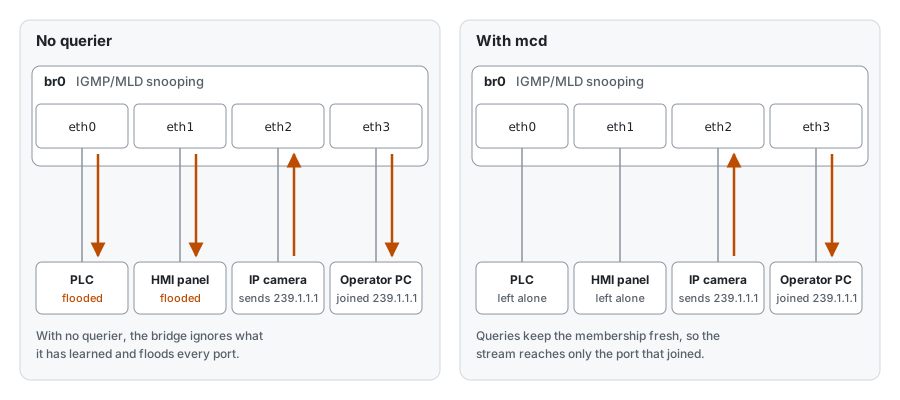 Figure 1: Bridge without a querier, flooding a camera
stream to every port, and with mcd, where the stream reaches only the
port that joined.
Figure 1: Bridge without a querier, flooding a camera
stream to every port, and with mcd, where the stream reaches only the
port that joined.
If more than one device can be the querier, they hold an election, and
the lowest address wins. A device without a usable address can still
send proxy queries, from 0.0.0.0 for IGMP, which never win. Proxy
queries keep the memberships fresh, but some end devices ignore them.
Their memberships then expire, and a group whose only member did that
is unknown again, and flooded.
In Infix OS
Enabling multicast on a bridge turns on snooping, and makes the bridge a querier candidate that uses its own address in the election:
admin@example:/> configure
admin@example:/config/> edit interface br0
admin@example:/config/interface/br0/> set bridge multicast snooping
admin@example:/config/interface/br0/> set ipv4 address 192.168.2.1 prefix-length 24
admin@example:/config/interface/br0/> leave
admin@example:/> show ip multicast
Multicast Overview
Query Interval (default): 125 sec
Router Timeout          : 255
Fast Leave Ports        :
Router Ports            :
Flood Ports             : e0, e1, e2, e3, e4, e5, e6, e7

Interface       VID  Proto  Querier                      State  Interval  Timeout  Ver
br0                  IGMP   192.168.2.1                     Up       125     None    3
br0                  MLD    fe80::ff:fe00:1                 Up       125     None    2

Bridge          VID  Multicast Group       Ports
br0                  224.1.1.1             e3, e2
br0                  ff05::1234            e5
The overview shows the bridge settings and the role of each port. The
querier table has one row per protocol: the elected querier, its query
interval, and a timeout of None when the bridge itself is the
querier. The last table is the MDB, with the groups that have been
joined and on which ports.
The defaults suit most networks. The settings worth knowing are:
querier, underbridge multicast, isautoby default. Set it toproxyto only send proxy queries when no other querier is present, oroffto never queryquery-interval, underbridge multicast, sets the time between general queries, 125 seconds by defaultbridge-port multicast router, per port, isautoby default and detects multicast routers. Set it topermanentfor a router that does not announce itselfbridge-port multicast fast-leave, per port, drops a group as soon as the port reports a leave. Use it on ports with a single end devicebridge-port flood multicast, per port, controls flooding of unknown groups, on by defaultbridge multicast-filtersholds static groups, for devices that do not report their memberships
On a VLAN filtering bridge, the same settings apply per VLAN, under
bridge vlans vlan <VID> multicast. If the VLAN has an interface with
an address on top, the querier uses that address. Otherwise it sends
proxy queries.
The Multicast Filtering and Snooping section of the user guide has more examples, including VLAN filtering bridges and static filters. Basic Bridge Networking covers setting up the bridge itself.
New in Infix OS v26.10: An MLD Querier
Up to now, the querier in Infix OS has been IGMP only. Infix OS v26.10 comes with mcd 3.0, which runs an MLD querier next to the IGMP one, each with its own election. IGMP queries are sent from the interface address, and MLD queries from its link-local address, as RFC 2710 and RFC 3810 require. Both start at the newest protocol version, IGMPv3 from RFC 3376 and MLDv2, and fall back while an older host is heard. The configuration is unchanged, a bridge that runs a querier now runs one for each protocol.
A host on port e0 sees both queries, each from its own address:
1
2
3
$ tshark -n -i eth0 -Y 'igmp.type == 0x11 || icmpv6.type == 130'
  1 0.000000000 0.000000000  192.168.2.1 → 224.0.0.1    IGMPv3 50 Membership Query, general
  2 0.014043869 0.014043869 fe80::ff:fe00:1 → ff02::1   ICMPv6 90 Multicast Listener Query
mcd began in 2021 as querierd, written at Westermo for WeOS 5. Westermo’s last release of querierd was v0.10, in May 2023. In 2024 its original author adopted it as mcd, and today it is the multicast querier in Infix OS. mcd runs on any Linux system with a bridge, and its release notes list everything new in 3.0.