Infix v26.10: Snappier, with QoS and IPv6 Routing
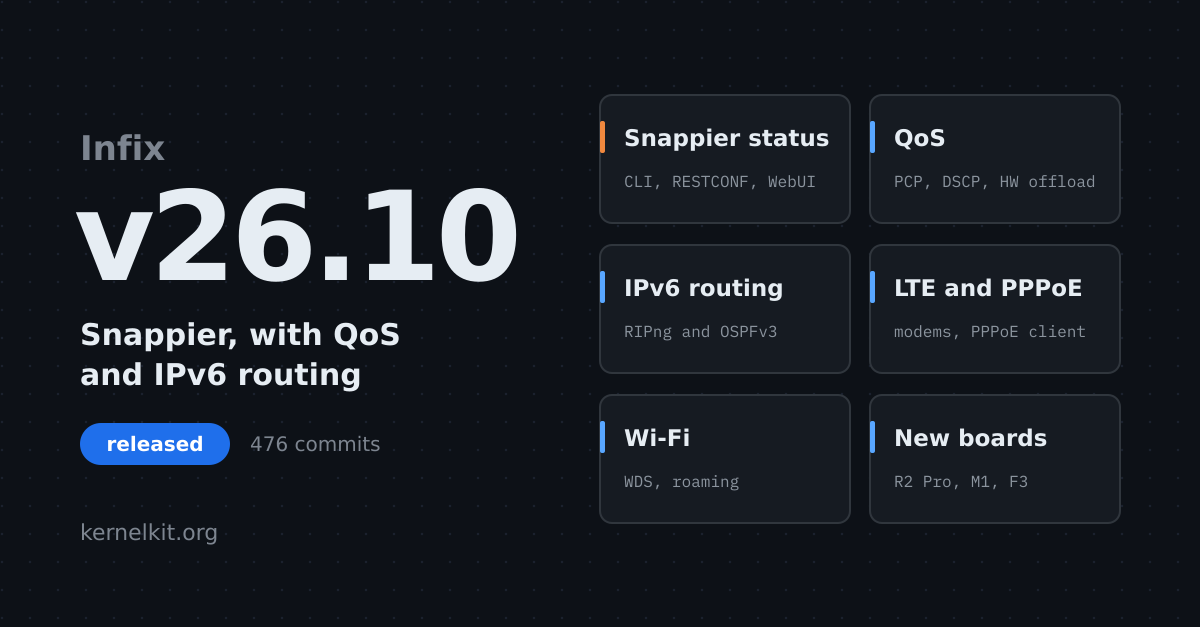
Infix v26.10 is out, with 476 commits in 62 pull requests since v26.09 a month ago. Thank you to everyone who sent code, tested release candidates, and reported bugs.
Snappier status
The big news this time is how snappy it feels. The system now keeps interface,
routing, bridge, Wi-Fi, container and hardware status up to date as
things change, instead of collecting it every time someone asks.
show interface, NETCONF and RESTCONF reads, and the WebUI status pages
answer right away. Big switches with lots of ports feel it the most.
The WebUI cashes in on it: status pages refresh on their own, and the Overview page has new Ports and Health cards that show link state and LLDP neighbors per port, and anything that needs your attention.
Quality of Service
Every port now has a QoS configuration: trust PCP or DSCP, map them to priorities, sort traffic into strict or weighted classes, remark on the way out, and cap the egress rate. Ports start with IEEE 802.1Q defaults, so you only touch what you want to change. On Marvell LinkStreet switches it all runs in hardware, so it applies to switched traffic too. The QoS guide has the details.
Routing and bridging
- IPv6 dynamic routing, RIPng and OSPFv3, next to RIPv2 and OSPFv2
- A WebUI Routing page that sets up OSPF and RIP in a couple of clicks
- A bridge forwarding database, static entries and
show bridge fdb - An MLD querier for IPv6, see Controlling Multicast on the LAN
- Changing an IP address or an STP port cost no longer bounces the link
If you script against NETCONF or RESTCONF, note that the OSPF and RIP settings moved to new YANG modules, the release notes have the details.
Getting online
Cellular modems are in: LTE dongles, mPCIe cards and M.2 modules, see LTE Modems in Infix. So is a PPPoE client, for providers that still require one.
On Wi-Fi, a station and an access point can now team up as a WDS link for bridges and repeaters. Stations roam on their own, and an access point hands its clients to a neighbor before it goes down for a reboot or an upgrade.
New boards
- Banana Pi BPI-R2 Pro, Rockchip RK3568, with Wi-Fi 6E and LTE
- Banana Pi BPI-M1, Allwinner A20, 32-bit Arm
- Banana Pi BPI-F3, SpacemiT K1, our second RISC-V board
The Tactical 1000 and other LAN969x boards get a long list of switch, PTP, and copper PHY fixes, and the BPI-R4 can now run an MT7615 card with a blank EEPROM.
Coming up
The x86_64 images now boot from a signed disk image. This is groundwork for verified boot on our Arm64 and RISC-V boards, more on that in a later release.
Get it
Images and the full release notes are on GitHub. Questions and feedback are welcome on the forum.